.png)
RF Coaxial Connector Selection Guide: SMA, SMB, MCX, MMCX, N and BNC Compared
Executive Summary
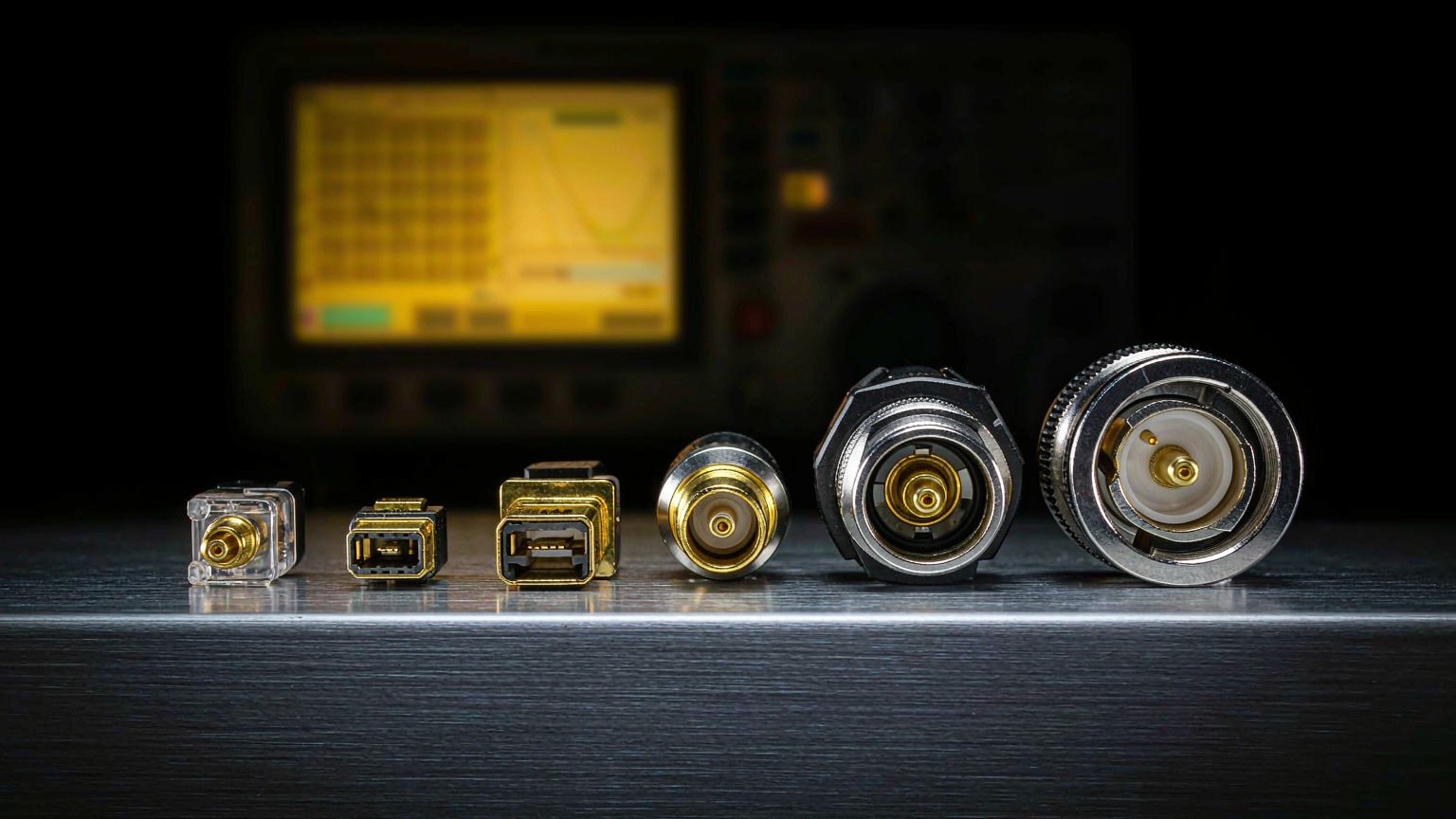
Six 50 ohm interfaces cover the overwhelming majority of RF and microwave work. They differ in frequency ceiling, coupling method and power handling — and picking the smallest one that fits is usually the wrong instinct.
RF connector selection is often driven by whichever interface the test equipment already has. That works until the link has to run at 12 GHz, survive a mast-top installation, or be mated daily. Here is how the six families we manufacture actually compare, using the published figures from our selection manual.
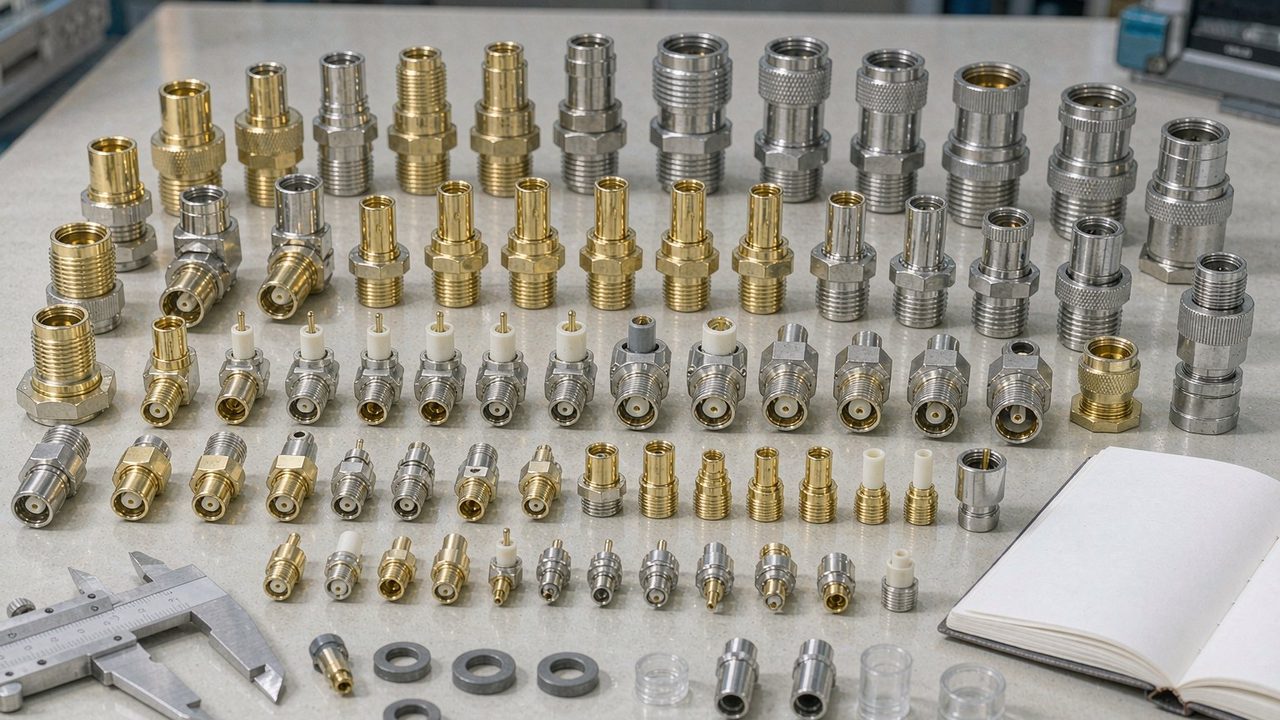
The Compact Threaded Option: SMA
SMA is the workhorse of laboratory and instrument RF. Our SMA range is rated for DC to 12.4 GHz on flexible cable and DC to 18 GHz on semi-rigid or semi-flexible cable, with VSWR of 1.15 + 0.02f or better and 1000 V dielectric withstanding voltage. Insulation resistance is above 5000 MΩ, contacts are gold-plated phosphor bronze and beryllium copper on a PTFE dielectric, and the range is qualified to GJB681A (MIL-C-39012).
SMA is the correct default for anything below 18 GHz that needs a positive threaded lock in a small envelope. Its limitation is mechanical: the thread is fine, the coupling nut is small, and over-torquing damages the interface.
The Snap-On Family: SMB, SSMB, MCX, MMCX
These four share a push-on interface and trade frequency range for size. All are 50 ohm with PTFE dielectric and gold-plated contacts, and all are specified at 500 mating cycles.
- SMB — DC to 4 GHz, 750 V dielectric, insulation resistance above 1000 MΩ, VSWR ≤ 1.3. The general-purpose snap-on choice.
- SSMB — DC to 3 GHz, 500 V dielectric, insulation resistance above 500 MΩ. Smaller than SMB for the same application class.
- MCX — DC to 6 GHz, 750 V dielectric, insulation resistance above 1000 MΩ, VSWR ≤ 1.3, to IEC 1169-36 / CECC 22220. Higher frequency than SMB in a smaller body.
- MMCX — DC to 6 GHz, 500 V dielectric, insulation resistance above 500 MΩ, VSWR ≤ 1.3, to GJB618A (MIL-C-39012) and CECC 22340. The smallest of the four, for weight-critical handheld and portable equipment.
Snap-on interfaces are not a substitute for a threaded one where vibration is present. They are designed for equipment that is assembled once and left alone, or for internal jumpers where the cable is strain-relieved independently of the connector.
The Bayonet Standard: BNC
BNC is the bayonet-coupled 50 ohm interface found on nearly every oscilloscope, signal generator and video router. Ours is rated DC to 4 GHz with 1500 V dielectric withstanding voltage, insulation resistance above 5000 MΩ and VSWR ≤ 1.3, qualified to GJB681A. The quarter-turn lock gives positive retention with fast connect and disconnect — the reason it survived in test environments where SMA would be mechanically tedious.
The Medium-Power Standard: N
N is the threaded interface for antenna feeders and base-station jumpers. Our range runs DC to 11 GHz with 1500 V dielectric withstanding voltage, insulation resistance above 5000 MΩ and VSWR ≤ 1.3, to GJB681A-2002 (MIL-C-39012). The larger geometry handles cable diameters and power levels that SMA cannot, and the thread holds under the wind loading and thermal cycling of an outdoor mast installation.
A Quick Comparison
- Highest frequency — SMA, DC to 18 GHz on semi-rigid cable.
- Smallest body — MMCX, DC to 6 GHz.
- Highest dielectric strength — BNC and N, both 1500 V.
- Best vibration retention — N and SMA, both threaded.
- Fastest field mating — BNC, quarter-turn bayonet.
- Lowest cost per mated pair in volume — SMB and MCX snap-on types.
The Mistakes We See Most
The first is choosing a snap-on connector for an application that vibrates, then adding a cable tie to stop it working loose. The second is running SMA at its frequency limit on flexible cable when semi-rigid would give three times the headroom. The third is mismatched impedance at the cable interface — a 50 ohm connector on 75 ohm cable produces a reflection that no amount of connector quality can fix.
Talk to a Hengyu application engineer:
Guangzhou Hengyu Electronic Technology Co., Ltd. · No. 188 Kaiyuan Avenue, Huangpu District, Guangzhou, China
Direct Inquiry Email: sales@hengyu-connector.com
Official WhatsApp: +86-20-87831269